
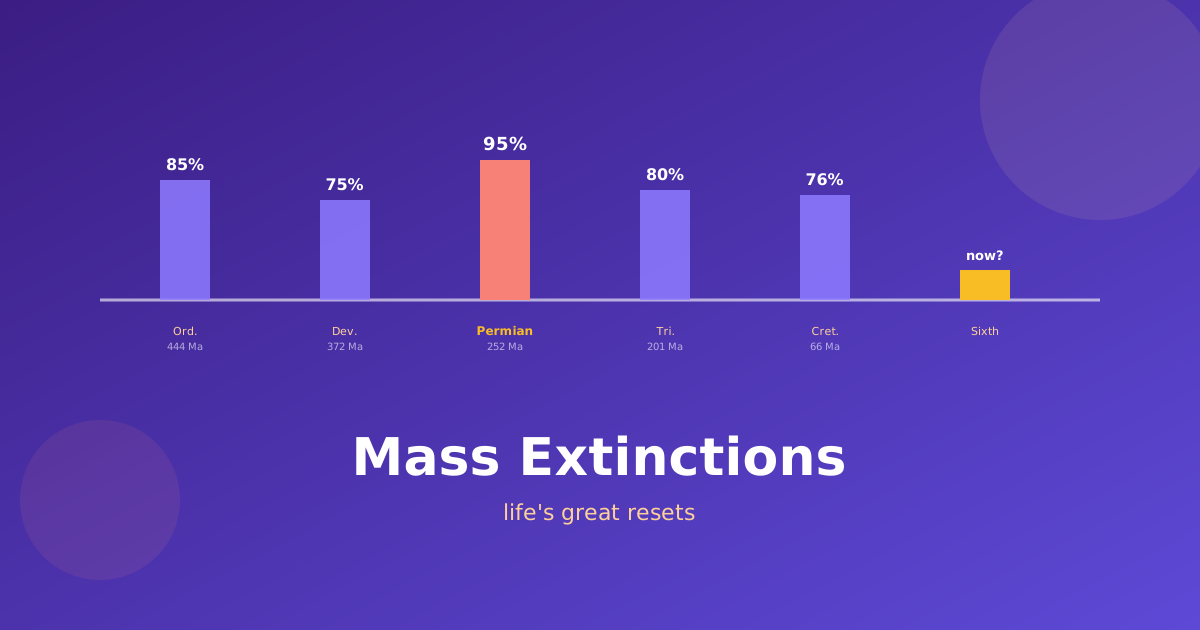
Life on Earth has come close to ending five times. Each of these episodes — the so-called Big Five mass extinctions — killed off most species on the planet in a geological eye-blink, and each one reset the trajectory of evolution. The world we live in is shaped less by 3.8 billion years of steady accumulation than by the recoveries from these five catastrophes.
A growing number of biologists also argue we're in the middle of a sixth right now.
What Counts as a Mass Extinction
"Mass extinction" has a specific meaning in paleontology: a relatively short period (geologically — sometimes thousands of years, sometimes millions) in which a substantially higher-than-background percentage of all species on Earth goes extinct, across many different kinds of organisms and habitats.
The "background" rate of extinction is real and constant — species go extinct all the time, often as part of the same speciation process that produces new ones. A mass extinction is the rare event that interrupts the normal pattern and rewrites the rules.
The Big Five are conventionally identified by spikes in the fossil record that show up across the entire planet at the same time.
The Big Five
1. End-Ordovician (~444 million years ago)
The first major mass extinction wiped out about 85% of marine species. (Life had barely started on land at this point.) The cause appears to be a combination of glaciation — sea levels dropped dramatically as water locked up in ice — followed by rapid warming and de-oxygenation of the oceans. The trilobites, brachiopods, and graptolites that defined Ordovician seas took heavy losses.
2. Late Devonian (~372 million years ago)
This was less a single event than a series of extinction pulses spread over several million years. About 75% of species disappeared. The seas were hit hardest — coral reef ecosystems collapsed and didn't recover for ~100 million years. Causes are still debated; leading candidates include rapid sea-level changes, ocean anoxia (oxygen loss), and possibly the spread of newly evolved land plants pumping huge amounts of carbon into ocean systems.
3. End-Permian (~252 million years ago) — "The Great Dying"
The largest extinction in the history of life. About 95% of marine species and 70% of land vertebrates went extinct. The cause was almost certainly volcanism on a scale unimaginable today: the Siberian Traps, a massive volcanic province in what is now Russia, erupted for hundreds of thousands of years, pumping enough CO₂ into the atmosphere to drive runaway warming, ocean acidification, and widespread ocean anoxia all at once. Recovery took roughly 10 million years.
If you take anything away from this list, take this: 95% extinction. The Permian came closer to ending complex life on Earth than any other event in geological history. Everything you see alive today descends from the 5% that made it through.
4. End-Triassic (~201 million years ago)
About 80% of species disappeared. The cause was again volcanism — this time the Central Atlantic Magmatic Province, an enormous volcanic event tied to the breakup of the supercontinent Pangea. The end-Triassic extinction cleared the way for dinosaurs to dominate the next ~135 million years.
5. End-Cretaceous (~66 million years ago) — The Famous One
The one with the asteroid. About 76% of species went extinct, including all non-avian dinosaurs. The Chicxulub impact off the coast of present-day Mexico released energy equivalent to billions of nuclear weapons, triggered global wildfires, threw enough dust and aerosols into the atmosphere to block sunlight for years, and disrupted photosynthesis across the planet. With photosynthesis disrupted, food webs collapsed from the bottom up.
The end-Cretaceous extinction is the most famous in part because of the asteroid (a dramatically photogenic cause) and in part because of what came next: mammals, which had been small nocturnal creatures during the dinosaurs' reign, suddenly inherited an empty planet and diversified to fill it. We are downstream of that recovery.
What Recovery Looks Like
Each mass extinction is followed by a long, slow recovery — typically several million years to even start, and often 10+ million years to reach pre-extinction levels of biodiversity. The recoveries are not just continuations of what came before. They produce new winners.
The end-Permian killed most of the dominant reptile lineages and gave rise to the world that would eventually produce dinosaurs. The end-Cretaceous killed the dinosaurs and gave rise to the mammalian dominance we now live inside. The Cambrian Explosion that produced most modern animal body plans — covered in The Evolution of Life: A Journey Through Time — was itself a recovery from earlier ecological resets.
This is the deepest lesson of mass extinction history: the world we live in is shaped less by continuous evolution than by what survived each round of selection imposed by catastrophe.
The Sixth?
A growing number of biologists argue that we are currently in the middle of a sixth mass extinction, driven not by an asteroid or volcanic event but by human activity. The evidence is in several lines:
- Background extinction rates in modern groups (birds, mammals, amphibians) appear to be running at 100 to 1,000 times the long-term background rate.
- Habitat destruction, especially the conversion of tropical forest to agriculture, has eliminated huge portions of the most biodiverse regions of the planet.
- Climate change is shifting the ranges of species faster than many can adapt, particularly in marine systems and in cold-adapted communities.
- Direct exploitation — overfishing, hunting, the wildlife trade — has driven specific declines that go well beyond any sustainable level.
The sixth extinction hypothesis is debated in its details but broadly accepted in the discipline. Whether it will reach the scale of the Big Five depends in part on whether the current trajectory continues or reverses. The full picture of what's at stake is in Biodiversity Hotspots: Protecting Earth's Most Vital Regions, and the role biology can play in the response is in The Role of Biology in Combating Climate Change.
Why It Matters
Mass extinctions are not just historical curiosities. They are the largest natural experiments in biology, and they teach lessons about resilience, recovery, and the limits of life that you can't get anywhere else.
They also offer perspective. Life has survived five planet-scale disasters and built back richer than before each time. It would be a mistake to take that as license — recovery takes millions of years, and most of what disappears in an extinction event never comes back — but it is also a useful counterweight to the despair that often surrounds modern environmental news. The biosphere is more resilient than it looks. It is also more fragile.
For the long view of how life rebuilds after these events, return to The Evolution of Life. For the present-day picture, see Ecology in Action: How Ecosystems Work.